There is a huge difference between simply playing gambling games for fun and playing with a meaning. A quiet, secluded night at a blackjack table in Las Vegas or a few hands of online poker from home might seem like harmless amusement. However, for many, that thin line between chance and logic is where all of the wonder lies.
Casinos are dependent on probability, not chaos. Every spin, every draw, every roll, goes with a pattern hidden within the numbers, and while most people play just to stir in some excitement in their life, some see the casino table as a puzzle to be solved. Knowing your odds, protecting your bankroll, and picking the right games can convert what feels like a blind guess to something almost close to a skill.
The Mathematics Behind Every Bet
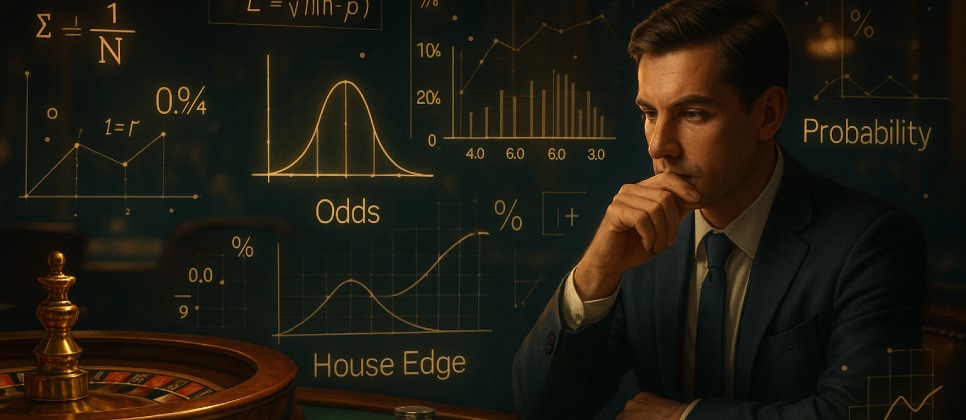
A slick mathematical truth goes behind every flashing light and shuffled deck. The world of casinos is generated by the theory of likelihood. The common language of risk decides who wins, who loses, and the house keeps how much. Most belated learners would rather depend on superstition or their instinct. If one would just do the math behind it, they'd quickly understand why casinos always retain an advantage: such advantage can be managed but never wiped out.
For example, depending on if it is European or American, the roulette table varies in pockets. European tables have 37 pockets, one of which is zero. That single green pocket gives the house a margin of 2.7%. On American wheels, which add a double zero, the house edge rises to about 5.26%. It is a marginal increase but, in effect, it doubles casino advantages in the long-term. Most players would not even notice it after maybe two or three spins, but after hundreds and hundreds of rounds that extra green slot seriously counts.
Likewise, Blackjack tells a similar story. But there is a little more maneuvering to be done with skill, and this is, in reality, one form. If the player, who is practically a professional in determining when to hit, stand, split, or double, wishes to lower the house advantage, he is capable of doing just that-to somewhere less than 1%. There are no guesses about it. It is mathematical and the will to stay with a proven course of action-and not deviate.
Why Bankroll Management Separates the Players from the Spectators
The second type of player is one who quietly tracks every chip, while the first type is chasing losses. Bankroll management might sound drab in comparison to spinning reels or flicking cards, yet this is the invisible facet that separates short-lived luck from sustainable play.
A responsible player sets limits upon sitting down. The simple rule is: never gamble money you need. But the practice goes farther than that because many employ a "session budget" approach, dividing the overall amount into smaller portions to be used for one game or application; that is to say, separate days. Another variation is the 1% rule: a maximum of 1% of the bankroll is used for any one bet.
This is where psychology comes in. With losses, the emotions start to get the better of people. The urge to “get it back” is overpowering and often results in rushing headlong into further reckless bets and poor decisions. Money management in that sense becomes less about finances, and more about emotional control. Money management is about knowing when to say stop, even when every fiber of your being is screaming to keep going.
Understanding the House Edge
The online casino concept is math. The house edge is an automatic profit margin set down to be the average percent that it keeps from every bet over time. It changes from game to game, and knowing about it should change how a player approaches the table.
The house edge in games such as baccarat or blackjack is generally relatively small, often from about 1 percent to 2 percent. Slot machines could be anywhere from 4 to 10 percent, depending on how they were designed and on the particular payout structure that they use. Statistically, this means that in every $100 wagered, a casino makes $4-$10. Sounds little on the dollars-and-cents scale, but this amount compounded across thousands of players is the mainstay of income for every casino.
Consider this from a player's standpoint. Winning runs bring much excitement, but those odds are stacked against a player. In the long run, the house gets what it is owed. The awareness of this fact does not jeopardize the fun of the game itself. It rather creates very reasonable expectations and makes every win feel worth it, as opposed to being owed.
Choosing Games that Reward Awareness
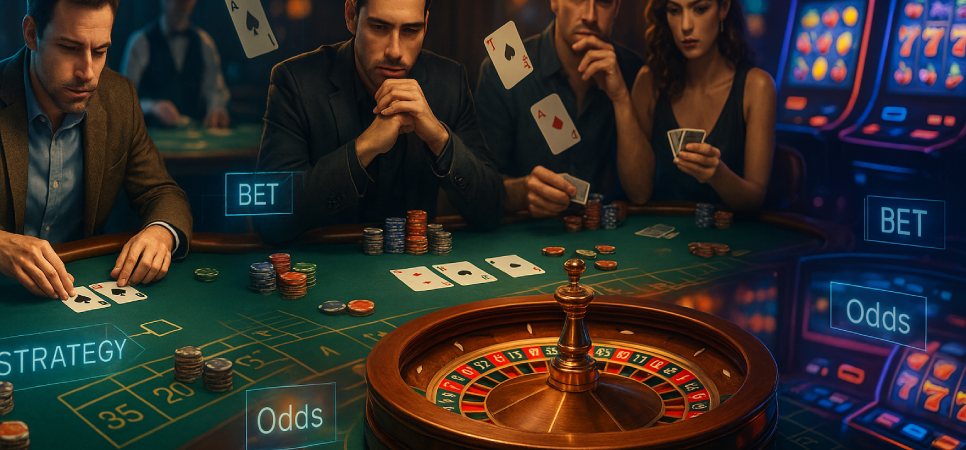
Not all casino games are created equal. Some rely almost entirely on chance. Others give room for skill, observation, and calculated risk. Choosing wisely can make all the difference.
Blackjack and the Power of Strategy
Blackjack, among all casino games, is still the one that strategic skill really affects. The basic strategy charts are calculated from probability and they represent the most statistically correct move for any combination of hands. Their utilization is not making a player get rich immediately, but it is decreasing the gap of the advantage lying within the player and the casino. The combination of card counting which is a legal, but in practice a taboo technique in most of the casinos, can and it does shift the predictive scales of the game dramatically in the player's favor. It is not a matter of chance, rather it is about having a good memory, being focus, and being calm.
Poker and Psychological Play
The game of poker, particularly in those intense live competitions, extends mathematics outside itself and integrates psychology. The distinction in the game is not just about the mathematical side. It's a live and fluctuating one that is human interaction-driven. One of the major elements of the strategy is reading the opponents, setting the pace and hiding the intentions as well as calculating the pot odds. A properly timed bluff can be more successful than a bad stats hand. That's why many professional gamblers are fond of poker — it is one of the very few places where the house is one step behind you and not beside you in the competition.
Roulette and Statistical Reality
Roulette, though primarily luck-based, still rewards awareness. European tables offer better odds, and sticking to even-money bets like red or black, odd or even, gives a steady rhythm with lower volatility. Systems like Martingale or Fibonacci tempt players with the illusion of control, but the mathematics rarely bend. The key lies in recognising that streaks, though real, don't change the underlying probability.
Slots and Risk Management
Slot machines often lure players with lights, sounds, and massive jackpots. Yet, among casino insiders, they're known as entertainment rather than opportunity. The return-to-player (RTP) percentage tells you how much of the wagered money a machine gives back over time. The higher the RTP — typically above 96% — the better your long-term odds. Even then, variance plays a role. Low-volatility slots deliver frequent small wins, while high-volatility games swing between dry spells and large payouts.
The Psychology of Playing Smart
A strong casino strategy isn't just about numbers. It's about understanding how the human mind behaves under uncertainty. Cognitive biases — from overconfidence to gambler's fallacy — shape decision-making at the table. People often assume a losing streak must end soon or that a “hot” machine will keep paying. Both beliefs are illusions. Probability resets with each spin.
Awareness of these mental traps can turn average players into disciplined ones. The best gamblers learn to detach emotionally, viewing the game as a series of independent events. Some even rehearse routines: counting to ten before betting again, or taking short breaks to clear the head. Little habits, but they help.
Learning from Data and Observation
A lot of players nowadays are not into superstitions. But data is what they use. There are online communities that distribute among their members the spreadsheets containing the results of thousands of spins or played hands, therefore showing how the outcomes are either grouped or deviating with time. Probability laws cannot be broken by data alone, however, it does help in finding the patterns in volatility and the payback cycles.
But, even in the traditional casinos, observations are used by the dealers. Those who have been gambling for a long time wait and analyze the table before getting into a game, by evaluating dealer rhythms, player practices, and even the frequency of a particular game's payout. It is not absolute, but if you have a sharp eye for the patterns, the instinct could be honed. Instead of being just a way of spending your free time, some may argue and say that it turns gaming into a field of study.
The Role of Patience and Discipline
The longer one spends in casinos, the more apparent it becomes that patience beats aggression. Chasing quick wins burns through bankrolls faster than most realise. The players who last — the ones who seem calm even after losing hands — share a common trait: discipline. They treat gambling like a long campaign, not a single battle.
Many professional players use stop-loss and win-limit systems. They decide in advance how much profit or loss ends their session, and they stick to it. That rule might sound rigid, but it protects against emotional decisions. After all, knowing when to walk away can be the smartest move of the night.
Discipline also shows up in game choice. A patient player studies the pace of a table before joining, looks for quieter dealers, and avoids emotional distractions. Casinos are designed to keep you inside — music, lights, free drinks, no clocks — all meant to blur your sense of time. Awareness cuts through that illusion. A disciplined player doesn't lose track of hours or value. They play on their terms, not the casino's.
Luck, Skill, and the Human Element
There's always luck. No matter how much one studies the numbers or perfects the method, chance remains part of the game's heartbeat. Yet, that's what keeps people returning. A perfect system would drain all excitement. Skill adds depth, but unpredictability adds life.
Casinos have thrived for centuries because they balance both forces. They offer games where awareness makes a difference but never total control. That tension between mastery and mystery is what keeps players alert. It's also what makes gambling a human story as much as a mathematical one.
The Line Between Fun and Obsession
Awareness isn't just about improving odds. It's about knowing when gaming becomes something else. A night of entertainment can slide into compulsion quietly. That's why responsible gambling messages are more than formalities. They remind players that awareness applies to behaviour as much as to probability.
Setting time limits, tracking losses, and stepping back when the game stops being enjoyable are signs of skill too. They reflect control — a quality as vital as knowing when to split in blackjack or hold in poker.
Conclusion
Playing with skill and awareness turns casino gaming into something richer than mere chance. It's a balance between knowledge and instinct, restraint and risk. The mathematics never lie, yet the human mind keeps finding ways to dance around them. Perhaps that's the charm of it all. Strategy doesn't guarantee victory, but it guarantees understanding — and in a place where luck rules, understanding is power enough.
For those who take the time to learn, every shuffle and spin becomes more than a gamble. It becomes a conversation with probability itself — unpredictable, unending, and always worth engaging with a little more care.