Online gambling has undergone an evolution from being a mere static display of lights and buttons to an immersive ecosystem where the principles of fairness, and data-driven precision are interwoven. Developers at expos like ICE London and SiGMA Malta this year made public the prototypes of completely virtual reality casinos, AI-operated tables, and games authentication via public blockchains. The transformation appears to be not just a minor enhancement but rather an alteration in the perception of digital entertainment. Today, millions of players regard gambling as a part of a larger, interconnected world.
Virtual Reality Casinos
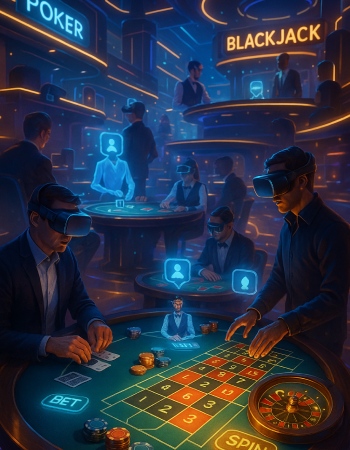
It has been almost ten years since the concept of VR gambling supposedly gained popularity, yet it is only now becoming a viable option for commerce. The whole scenario of entering a virtual casino does not seem to be totally unreal anymore, thanks to cheap headsets, super-fast internet, and portable gadgets.
Immersion Beyond the Screen
At the last ICE London, there were a number of studios that showcased the full-fledged interactive casino environments. A player could enter a 3D lobby, continue playing at a poker table, and switch to another player through the voice chat that was going on in real time. The experience is not perfect, though. Sometimes the avatars get stuck, and the graphics lag a bit in busy hours. Nevertheless, the presence is quite clear. When a player in Sydney locking eyes with the one in Manchester, the game virtually turns to be much more than just a game.
Moreover, VR has an impact on people's behavior. It slows players down and brings back the pauses that were already beyond mobile apps. You can't just keep pressing the button rapidly. The atmosphere itself fosters attentiveness. The social dimension introduces pressure, affection, and brief occasions that are akin to those in a real casino.
The Metaverse Casino Idea
Developers at the moment are exploring hybrid arrangements where live dealers are recorded in studios and VR players exist as digital avatars on the same table. It is somewhat experimental but exhibits the direction the industry is moving to. Certain studios have initiated conversations about the complete virtual casino resorts that would accommodate concerts, tournaments, and branded rooms. A creative director at SiGMA described it as “a digital Vegas designed for those who never leave their couch.” It might sound bold, but based on the speed of development, it is not long before it happens.
Blockchain and Transparency
The principle of fairness has always been the basic rule of gambling, and technology based on blockchain is now providing players with a means to witness it by live demonstration. The technology makes it possible to remove blind trust since it registers every result of the game on the public ledger. Gamers are able to check the legitimacy of their wagering actions like each spin or card draw on their own.
Provably Fair Systems
Provably fair gaming is based on cryptographic hashing which makes it possible for each result to be checked independently. Once a round is over, the player and the operator are both able to verify whether or not the result corresponds to the seed. It is impossible for anyone to change it after it has been done. It may sound complicated, but the trust it brings is very straightforward and very strong.
Faster and Borderless Payments
Payments that are based on blockchain technology have changed the way money is transferred. Notably, a few crypto casinos have started to process their withdrawal requests in under five minutes. The players are free now from banks waiting times and intermediaries for payments. Stablecoins, such as the USDT and USDC, are gaining popularity as the deposits since they are stable and do not incur any currency conversion fees.
The situation is still a bit of a learning process for the regulators, though. In some locations, crypto casinos operate outside of the conventional regulations and therefore produce a legal grey area. The government agencies are gradually but certainly nurturing the idea that acceptance could be a better path than prohibition. This line of reasoning allows for the birth of new concepts while at the same time, consumer protection is being monitored.
AI Dealers and Intelligent Systems
Artificial Intelligence has taken a significant place in almost all gambling platforms. Initially, it was only the customer support and recommendation tools but later on, the AI has become the main factor even in the gameplay.
Digital Hosts at the Table
AI dealers have the ability to monitor the players' behavior in terms of betting, speed, and tone. A few prototypes even go so far as to use memory in order to identify the returning users. Thus, it becomes a personalized experience and the players stay engaged through the absence of human staff.
There is no chance of AI dealers making mistakes while calculating bets or getting exhausted after lengthy rounds. They are capable of managing multiple tables simultaneously with the same accuracy. The aim is to not only to automate the whole process but also to give the digital player the feeling of being personal again.
Safety and Player Wellbeing
AI is likewise a tool for unhealthy gambling behaviour detection. The systems will pick up on the unusual practices that are going on like: fast-depositing, changing the bet size quickly, or playing in an irregular manner for short or long periods. Whenever such practices are detected, the platform can put the user's session on hold automatically or suggest taking a break.
There is a possibility that the technology that is meant to protect users could be misused instead. For instance, the use of predictive algorithms might lead to users playing longer with the justification of “personalisation.” To avoid this the authorities and the creators of the software are already discussing the necessity of introducing rules on transparency for all AI-driven features.
Fairness and Game Verification
Licensing was the main guarantee of fairness at first. These days, however, data transparency is equally important. A lot of operators disclose comprehensive data about their gaming activities such as RNG audits and statistical analysis.
Third-Party Testing and Open Data
To validate the return-to-player percentages, independent laboratories conduct simulations of millions of game outcomes. In order to maintain complete openness, some of them even broadcast the testing procedure live over the Internet. Still others rely upon blockchain records whereby the reports cannot be changed afterwards.
Multi-Chain Fairness Experiments
At present, the multi-chain verification systems, which compare random outcomes of different blockchains, are being tested by the developers. This procedure introduces redundancy, but at the same time, it significantly reduces the risk of tampering. It is still ongoing, but nevertheless, a majority of the experts think the technology might be considered as the new standard for the industry in a few years.
The Social Layer of Play
For quite a stretch of time, virtual gambling seemed to be a lonely affair. It is no longer the case. The communal gambling experience is coming back, with the help of new tech.
Cross-Platform Play
From now on, players have the option to change the device they are using without any break in their gaming session. A person could for instance, start playing a round of blackjack on a laptop and then take over on a VR headset. There is no disruption in between. The whole thing is so smooth. The integration of chat and streaming has been done in such a way that the users can communicate, see the game, and also bring in an audience if they wish.
Turning Games into Events
Poker tournaments today are live streamed just like esports with announcers and audience's instant reactions. The boundary between spectator and player is getting less pronounced. Most of the participants consider it mainly as a form of entertainment and only then as a way to wager their money. Such a transformation in attitude may very well be the most significant change in the sector in the long run.
Responsible Gambling Through Data

Tech advancements are not only benefiting the gaming experience but also ensuring safety in a better way. Cutting-edge methods in data analysis are applied by contemporary casinos to recognize nascent phases of danger.
Behavioural Insights
Behavioral changes others are not even aware of get subtly tracked by the algorithms including play time, deposit frequency, etc. In case the patterns indicate risk, the system would instantaneously intervene. Some of the sites temporarily restrict player spending or recommend taking a break till the player reaches a critical level of activity.
Collaboration Between Tech and Health Experts
Anonymized player data is being utilized for academic research into gambling psychology in Canada, Sweden, and the UK among others. The aim is to prevent practice rather than to penalize it. The academic industry collaborations have generated new responsible gambling practices that are being accepted in several licensing authority areas, as well.
Regulation and the Path Forward
Technology often moves faster than law. Regulators around the world are now trying to define what a “casino” even means in digital terms. A VR casino does not fit neatly into existing categories. Should it be treated like a website or like a physical venue?
In Europe, the Gaming Institute is drafting new guidelines that define gambling based on mechanics rather than location. Instead of asking where the game happens, regulators focus on how bets are made and results produced. This practical approach gives them flexibility as technology evolves.
In the United States, states such as Michigan and New Jersey are studying how to handle virtual environments, while Asian regulators are looking closely at blockchain traceability to prevent fraud. There is no single answer, but the common thread is accountability.
Looking Ahead
Technology will not remove risk, but it might finally make gambling transparent and self-aware. The future casino will be less about flashing screens and more about interaction, verification, and safety.
By 2030, a typical player may step into a digital lobby, greet an AI dealer, and play a blockchain-verified game surrounded by friends from across the world. The tools are already here. The only question is how responsibly the industry will use them.